Monday, April 9, 2012

J. JENKINS WINERY


Retired pediatrician Jim Jenkins has been making wine for many years, and doing so commercially since 2003. He and his wife Jeanne have ten acres of vines and apple trees just two miles north of Julian. Their estate grapes include Pinot Grigio and Pinot Noir; Jim sources additional grapes from Ramona and other SoCal vineyards.

We were happy to find the Jenkins’ original tasting room re-opened after a hiatus. And we liked the Dolcezza apple wine! With only 0.5% residual sugar, it'll be a pleasant summer sipper. The 2009 Estate Pinot Noir has mineral notes and more weight than we generally encounter; it would be perfect with salmon. But the 2004 Syrah with its smoky and grassy nose won the day. What an amazing find for $25 – and the grapes came from Pyramid Vineyard, just down the road in Ramona.

The Jenkins estate includes kid- and dog-friendly picnic spots. In early fall look for a farm stand too, with tomatoes, pears… and of course apples and cider.

The J. Jenkins tasting room is open Thursday – Sunday 11:00-5:00.  760.765.3267

A DAY OF BOTTLING AT MILAGRO FARM VINEYARDS & WINERY


The Bottling Truck

March 14, 2012
April helped out with bottling at Milagro this week. Home in San Diego after a long day, her first thought was, "Wow - I'll never look at a wine bottle the same way again!" Here are the details:

Our work started with re-stacking and moving pallets to make room for all the newly bottled wine. Most of the heavy lifting involved a forklift or pallet jack navigated by winemaker Jim or farm managers Tony and Olga. We volunteers made sure that plenty of wine was ready for the tasting room crew.


Moving stuff around
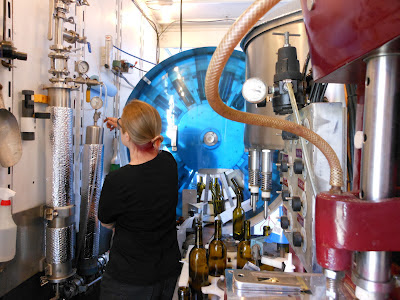
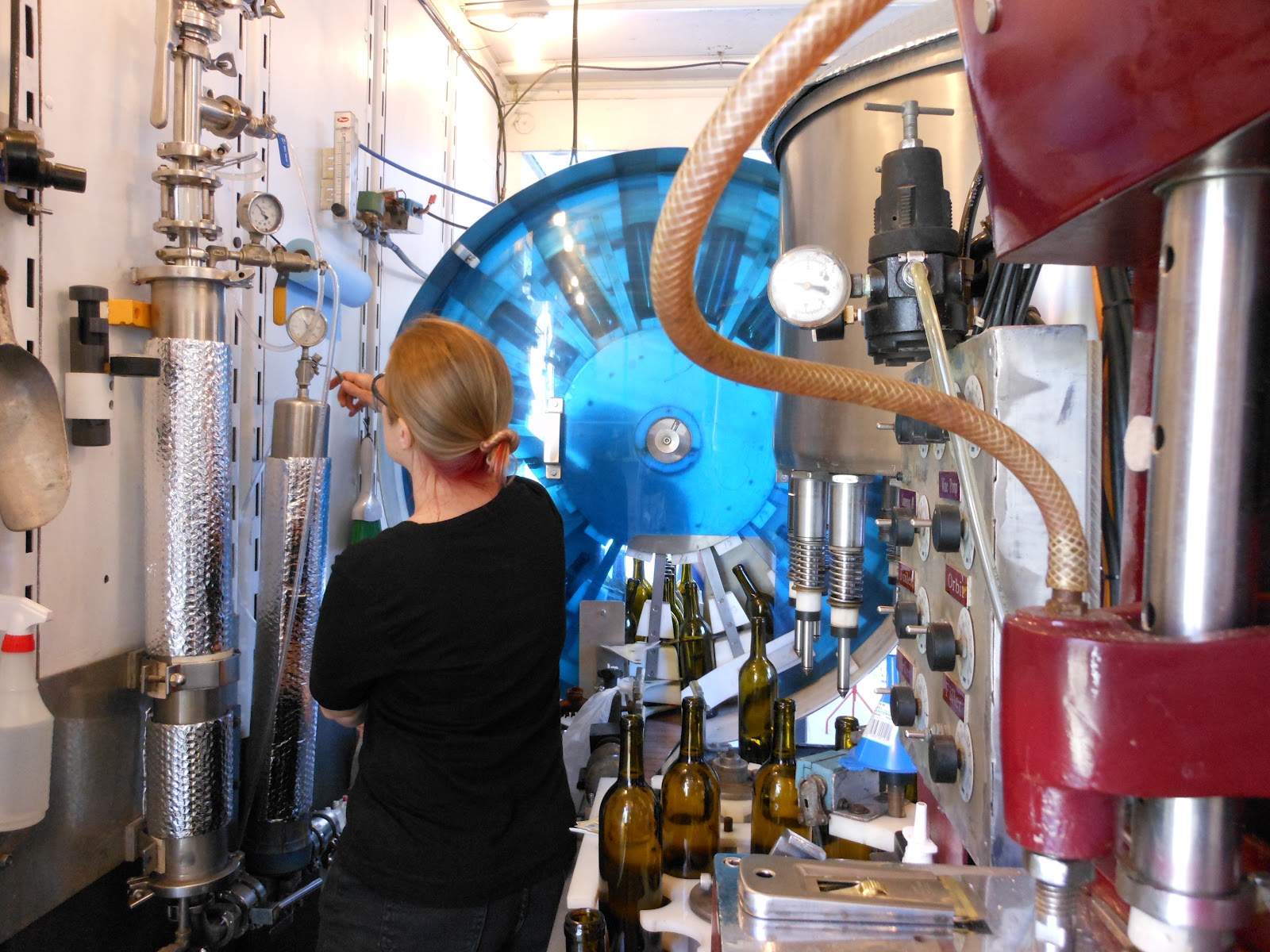
While we rearranged things, bottling truck owners Dan and Rebecca were busy sterilizing and preparing the system that would transport a big batch of Sauvignon Blanc from its tank to theirs.

Prepping the lines
In the blue wheel, nitrogen sterilizes the bottles

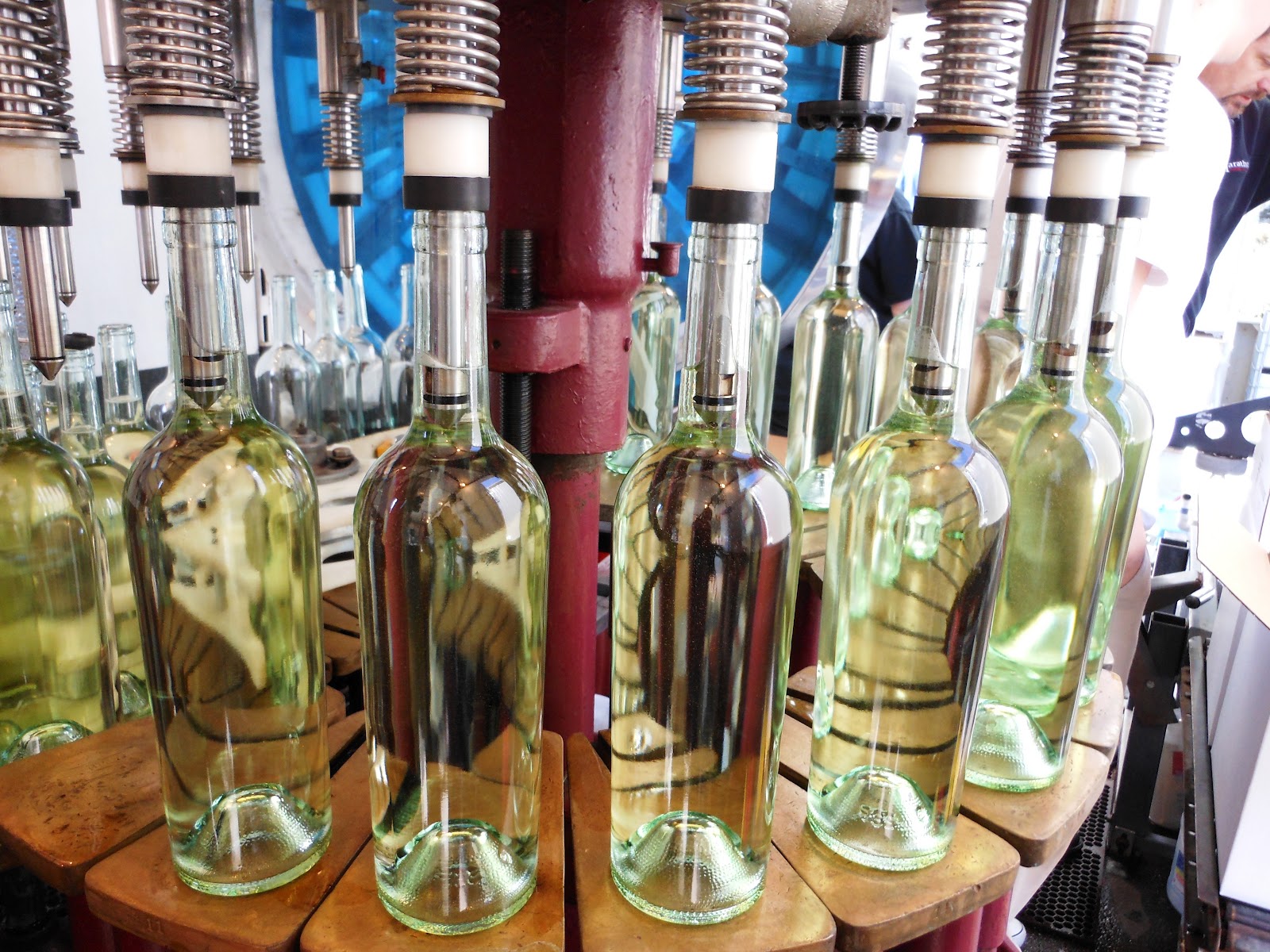
Filling bottles of Sauvignon Blanc

We finished the day with a small batch of Rosé.

This machine seals foil capsules over the corks.

The wine travels through a filter into the bottles, which then pass through some rather ingenious corking machinery. After that come foil caps, labels, quality control, and then the bottles are ready to box up and stack on pallets. With competent humans stationed all along the production line, it all functions like clockwork, right? Well, maybe on a really good day. But next time you look at a  bottle of wine, pay attention to its shape, the material the label is made of, and the label's position. Then think about how easy or difficult it would be for a machine to smoothly attach that label to bottles coming along a conveyor belt. We certainly encountered some challenges during the day's first bottling, but nothing will go to waste. The experience made me seriously consider, for the first time, the effort boutique wineries put into their packaging - from the color and weight of the glass to the size and composition of the cork to, of course, the label. At the end of the day we'd bottled almost 500 cases. Besides the satisfaction  of a job well done, we'd made new wine-lover friends. I wouldn't want to do this every day, but I'd certainly do it again.


April 9, 2012
Update: The next day another crew helped bottle two more Milagro Estate wines (vintage 2010): a classic, well balanced Sangiovese and a standout Barbera with dry cherry on the front and nice tannins on the finish. Mmmm... We had the Barbera with dinner last night.

Link to first Milagro post...

Wednesday, March 28, 2012

SAN ANTONIO WINERY


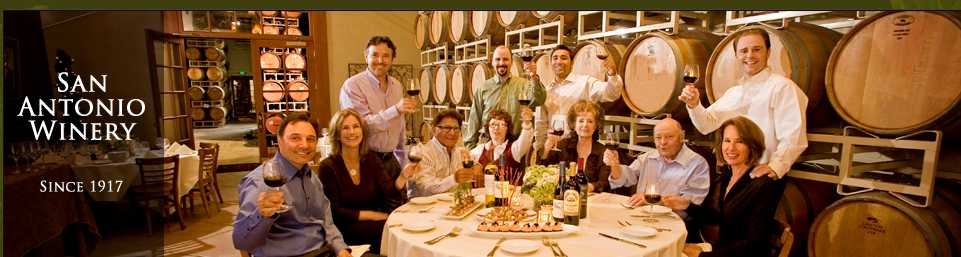
We don't often visit wineries that bottle about 500,000 cases a year and ship all over the world. Boutique this isn't! But it's L.A.'s only winery and a historical landmark with deep roots. Established in 1917 by Italian immigrant Santo Cambianica, whose nephew Stefano Riboli later joined him in the business, San Antonio has stayed in the family through multiple expansions and modernizations. For a long time the Ribolis specialized in sweet wines; they still do an astonishingly brisk business in the Stella Rosa brand, which they import from Italy. Also of note: they're the largest wine supplier to the U.S. Catholic church.

Almost there!

The wines produced in San Antonio's expansive facility come from the Riboli family's vineyards in Rancho Cucamonga, Paso Robles, Monterey, and Napa. All the crushing takes place in the vineyards, as does fermentation for the reds. The whites ferment on-site in huge, climate-controlled steel tanks. Right next to them, retired California redwood tanks hark back to earlier times. Our knowledgeable and entertaining guide Christopher Cuyler talked history and winemaking terminology as he took us through rows and rows of American and French Oak barrels, stacked to the ceiling, in which the red wines age fourteen months to two years. Next he explained the winery’s formidable, fully automated bottling system.


Steel fermentation tanks

Chardonnay lees
Bottling machinery

Visitors to San Antonio are invited to taste three wines at no charge or to try an “artisan series tasting” for $10. We chose the latter, and especially liked the 2007 Paso Robles Pretty Penny Vineyard Estate Syrah. Complementary tours take place Monday-Friday at noon, 1:00, and 2:00 and weekends between 11:00 and 4:00, on the hour. The winery sells a diverse selection of wine, beer, and spirits from around the world. There is a restaurant serving lunch and dinner (last seatings are at 6:15, 7:00 on weekends) as well as three dining rooms that can be reserved for private events.

Store and tasting room

737 Lamar St., Los Angeles
Open daily
323.221.7261

Monday, March 26, 2012

CORKBAR


403 W. 12th St., Downtown Los Angeles
213.746.0050

In Corkbar's roomy downtown space, guests can choose from more than fifty wines by the glass – all from northern and central California. The general palate is quite fruit-forward, but we encountered a couple of Pinot Noirs to our liking: 2009 Foxen (Santa Maria) and 2009 Morgan (Monterey). There are also whites from Alma Rosa, one of our favorite Santa Barbara County wineries.


The prices may seem a bit steep, but pours are generous and our bartender Rob was happy to offer a few tastes.  There’s also beer and food worthy of a snack or a meal. We'd love to see some SoCal wines here!


SOUTHERN CALIFORNIA WINE HISTORY

San Diego County played a significant role in the history of California winemaking. The county’s wine roots extend back to the early 1800s, when San Diego was still part of Mexico. Mission San Diego de Alcalá (its basilica is the heart of Old Town) was well known for wine.


The Basilica, Mission San Diego

Most wine enthusiasts don't know that, back in the day, there were over a hundred wineries in Los Angeles County. Joseph Filippi Winery, established in 1922, is one of the last reminders of the region's viticultural history. The Filippi family still owns 80 acres in Cucamonga, producing around 40,000 cases per year of red varietals and fortified wines. Guests can taste at a bar was cut from the largest redwood wine cask in California. 

A bit of Filippi family history
(Click Photo)

Likewise, European immigrants took up planting, harvesting, and fermenting the produce of San Diego County's vines. The Otay Valley was home to a large community of Italians and, towards the late 1800s, produced more wine than anywhere else in the county. Meanwhile, French immigrants were establishing themselves and their vineyards in the town of Nuevo (present-day Ramona), Julian, and Vista. Early 20th-Century customers at the wineries and wine shops such as Bradley's in downtown San Diego were encouraged to bring their own casks of gallon jugs for filling; bottling was the exception, not the rule. Aged and/or imported wines were definitely not for the average person.

Grape growing increased during Prohibition because grapes could be legally sold for home winemaking. Post-Prohibition there was a short upsurge in commercial winemaking, but during World War II rationing, labor shortages, decrease in wine consumption, and huge profits to be made in growing food for the war effort nearly destroyed the region's wine industry. The post-war generation didn't emmbrace wine the way their parents had; hard liquor and beer becaue the alcoholic beveragees of choice.

Now things have changed again. According to historian Richard Carrico, whose 2007 monograph History of the Wineries of San Diego County informs this post, "San Diego is poised to take its place in the surging Rhone style wine craze and the Cal-Italia surge. Escondido, Ramona, Fallbrook, and Julian may never be Sonoma or Napa but they could become something in the wine world that is uniquely San Diego County.”

Cheers! Carrico is in the process of updating his work; we’ll keep you posted.

Some Historic SoCal Wineries

Bernardo (founded 1889)
Tasting room open daily
13330 Paseo Del Verano Norte
San Diego

858.487.1866

San Antonio (founded 1917)
Tasting room open daily
737 Lamar St.
Los Angeles
323.221.7261

Joseph Filippi (founded 1922)
Tasting room open daily
12467 Base Line Road
Rancho Cucamonga
909.899.5755


Galleano (founded 1933)
Tasting room open daily
4321 Wineville Road
Mira Loma

951.685.5376